
When you start a real estate company, choosing a name is a huge decision! Below, I share a list of real estate company names categorized by niche for you to draw inspiration from. You’ll find that many popular and top firms incorporate terms like “Realty,” “Properties,” and “Group.” Which will you choose for your business?
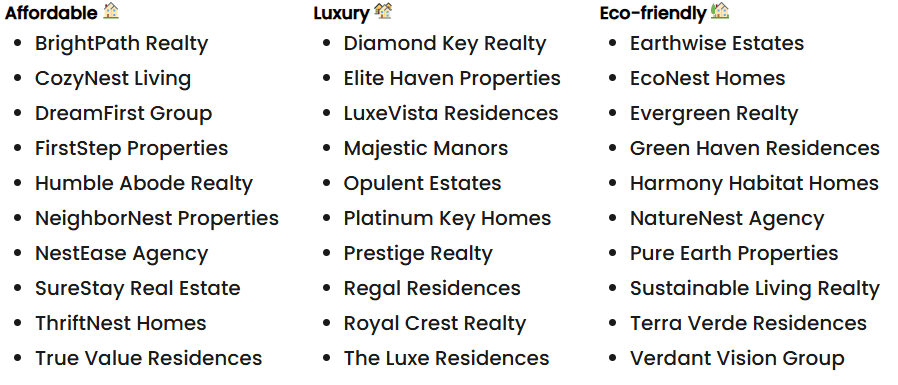

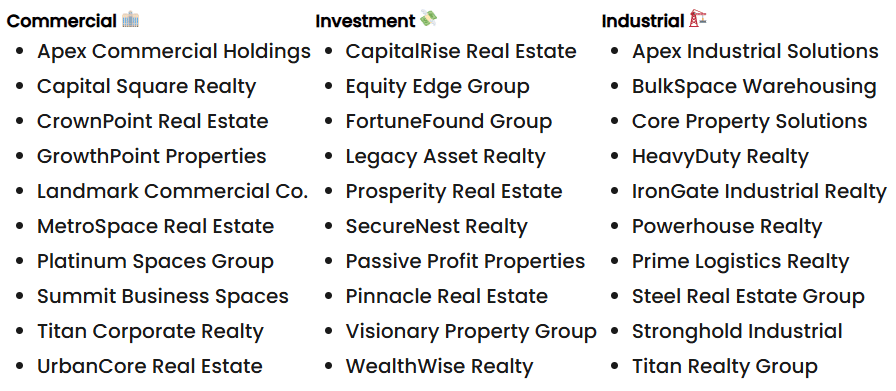
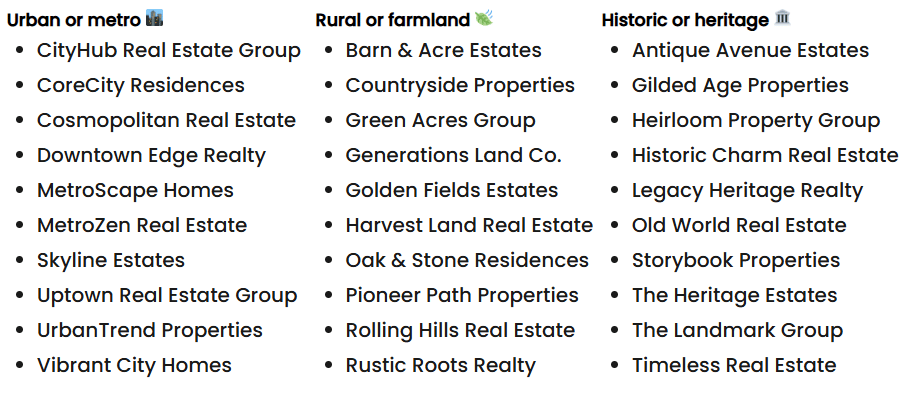
How to Come Up With Your Real Estate Company Name
Selecting the right real estate agency name lays the foundation of your brand identity. I’ll walk you through how to create a real estate business name that will resonate with your target market — from defining your brand values and audience to considering the name’s impact on SEO and comparing the name’s uniqueness against competitors.
Step 1: Define Your Brand Values and Audience
What’s your company’s unique selling point (USP)? What message do you want to communicate to clients? Who is your target client? Identifying your target market and brand values will guide you in choosing a company name that perfectly reflects your business’s identity.
- Company name: Eco Nest Group
- Target market: Professionals and families seeking homes that are convenient and sustainable.
- Brand values:
- Trust and transparency: We extend clear, client-first real estate services.
- Sustainability: We provide eco-friendly homes with energy-efficient designs.
- Innovation: We offer smart home technology integration for modern living.
- Slogan: “Building tomorrow today.”
- Tagline: “Connected. Sustainable. Smart.”
- Brand colors: Earthy greens, warm neutrals, and sleek blues to symbolize trust, sustainability, and innovation
Related read: Real Estate Branding
Step 2: Review Your Market, Services, and Growth Plans
Your real estate company name should target those you want to market to. Are you working in retirement communities in Florida or selling warehouse spaces in LA’s Arts District? As you can imagine, those two companies should have very different names if they want to reach the right clients.
As you grow as an agent or broker, you’ll naturally want to expand your business coverage, so ask yourself where you want to be in five or ten years. Are you in that same town, or have you expanded to neighboring areas? Consider your business’s long-term goals and ensure your company name is versatile enough to accommodate changes in locations, target audiences, and services.
Come up with as many real estate company name ideas as you can. The more you come up with, the better! Explore different themes, word combinations, and concepts. Once you have a list of potential names, evaluate each and compare them against all the others on your list, and against active real estate companies. You don’t want to sound similar to your competitor. Narrow your options down until you find the perfect fit.
Step 3: Consider Your Business Name’s Impact on SEO
- Keyword relevance: Include real estate terms (e.g., “Realty” and “Brokerage”) to help your company appear in searches related to buying, selling, developing, or renting properties (e.g., “West Coast Real Estate” is more SEO-friendly than “West Coast Group.”) Also, keep your name natural and descriptive, as Google penalizes spammy or overly generic names that seem manipulative (e.g., “Best Homes Buy Sell West Coast”).
- Clickthrough rate (CTR): Use a unique name to increase brand searches, which Google sees as a positive ranking signal (e.g., a creative, relevant name like “West Coast Real Estate” may attract more attention than a generic “West Coast Group”).
- Domain name matching: Pick a company name with an available domain name to improve direct traffic and search rankings. For example, if your company name is West Coast Real Estate, then choosing a real estate domain name like “www.westcoastrealestate.com” is more effective than “www.wcre.com” or “www.wc-real-estate.com.”
- Social media: Choose a simple SEO-friendly name that makes it easy to maintain consistent business listings across directories like Google My Business, Zillow, Yelp, and Facebook. Ensure it’s easy for people to tag, mention, and find you on socials, so avoid special characters and numbers. For instance, with West Coast Real Estate as your name, consider using:
@westcoastrealestate on Instagram and LinkedIn; avoiding @west.coast_real_estate.2025
www.facebook.com/westcoastrealestate; avoiding www.facebook.com/west.coast.re2025
Ensure you buy a domain that is easy to spell and relevant to your business and location. Once you’ve acquired it, build a website that showcases your expertise, services, agents, and property listings. Incorporate your logo, slogan, and other branding elements into your website.
Search for your desired social media handles and domain names before finalizing your company name. If another business has already staked its claim, it’s time to find a new name.
Since competition for online real estate has intensified, claim your social media accounts and get them up and running early in your brand creation. Establishing a strong online media presence is no longer an option — it’s a necessity for staying relevant in the industry.
- Long-term branding: Avoid names that aren’t future-proof and may lose relevance over time. Instead, go with a timeless, professional name that helps build long-term SEO authority. Consider these examples:
-
- West Coast Cribs, where “cribs” is a slang term that may go out of style
- Surf & Turf Estates, which leaves people wondering whether you’re selling homes or steakhouses
- Sunset Elite Realty, where “sunset” and “elite” are overused in the industry
- West Coast Cribs, where “cribs” is a slang term that may go out of style
-
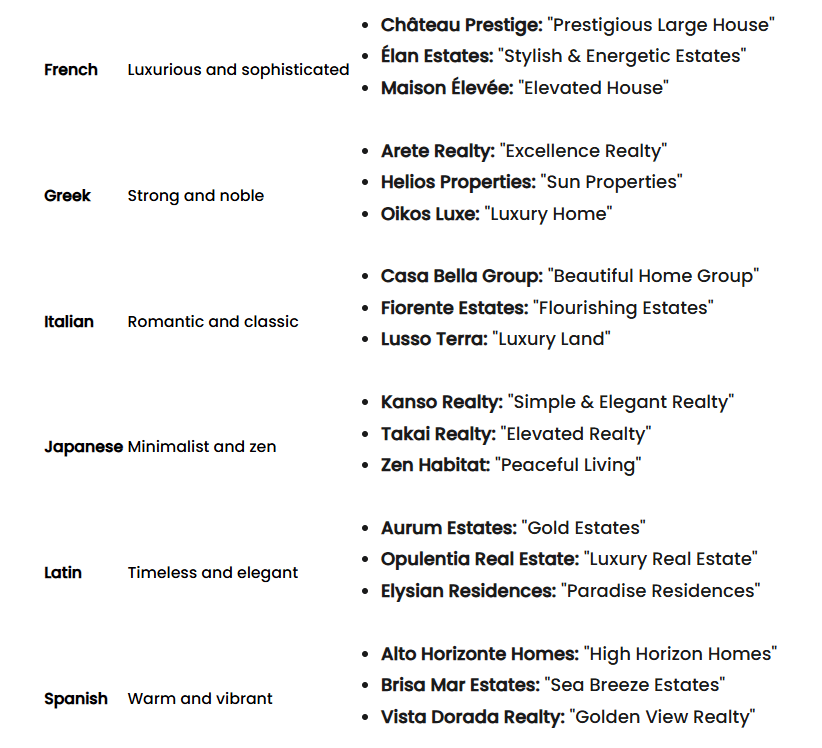
Step 4: Consider Sophisticated Naming Using Foreign Words
Consider incorporating foreign words into your real estate company name to convey luxury, prestige, or a deeper meaning. Here are some examples.
Step 5: Research Your Competitors’ Company Names
To establish a unique identity and prevent client confusion, avoid choosing a company name that is too similar to your competitors. This is critical because you don’t want leads visiting your competitor when they’re trying to contact you.
Here are some tips you can follow to avoid duplicating a competitor:
Step 6: Keep the Name Short and Simple
Have you ever noticed how the world’s top companies have short names? Some are recognized only by their acronyms, e.g., BMW, BBC, KFC, and GE. This brand recognition strategy is why keeping your company name short and simple is crucial.
Consider these tips for a short business name:
- Make your name short and easy to spell. In business, a brief company name is preferable for easy recall. Opt for simple, easy-to-remember names to avoid confusing leads. A concise name also works well for branding and marketing materials such as logos, business cards, social media handles, and other real estate marketing materials.
- Pay attention to how your company name sounds when spoken out loud. Your name may look great on paper, but how will it sound when a client talks about your company over lunch with a friend? One of the best ways to do this is to write down your name and see if your co-workers and even strangers can pronounce it easily. Does it roll off the tongue, or do they stumble while trying to say it?
- Consider your company name’s acronym. Assess how it aligns with your brand identity. Even if you don’t plan to use it for your real estate name, ensure it doesn’t accidentally convey anything lewd or tasteless. A recognizable acronym can improve visibility in marketing materials and strengthen brand recall.
What to Avoid When Choosing Real Estate Company Names
Knowing what to avoid when naming your company can streamline your decision-making process.
- Names with puns, pop culture references, and cliches: Choosing a company name that leans on puns, pop culture references, or cliches may seem great, but it can quickly become outdated or fail to connect with your audience. Will everyone find it clever? The answer, of course, is no. Puns, pop culture references, or cliches may not translate well across cultures and age groups, limiting your brand’s appeal
- Long names: A long and complex real estate name can be challenging to remember, pronounce, or type, which affects brand recall and accessibility. In addition, it may need to be more visually appealing in your marketing materials, such as signage, business cards, and print ads. Opt for a short and memorable name that’s easy to remember, spell, and pronounce.
- Trademarked names: Selecting a trademarked name can only lead to legal conflicts, costly rebranding efforts, and a damaged reputation. To verify the availability and legality of your desired company name, use search engines, social media, and trademark databases. Additionally, consult legal experts, as it’s always better to be safe than sorry.
Exercise caution when using the term “Realtor.” Since the National Association of Realtors (NAR) owns the trademark for the word, it has rules for its use. For example:
- If you’re not a dues-paying member of NAR, you can’t use it at all.
- If you are an active Realtor, there are still restrictions around using the word in your branding. Read NAR’s Membership Marks Manual to ensure you’re committed to long-term association membership before you tie your business presence to this protected and regularly policed brand name.
What to Do After Selecting a Real Estate Corporation Name
Knowing what to avoid when naming your company can streamline your decision-making process.
- Names with puns, pop culture references, and cliches: Choosing a company name that leans on puns, pop culture references, or cliches may seem great, but it can quickly become outdated or fail to connect with your audience. Will everyone find it clever? The answer, of course, is no. Puns, pop culture references, or cliches may not translate well across cultures and age groups, limiting your brand’s appeal.
- Long names: A long and complex real estate name can be challenging to remember, pronounce, or type, which affects brand recall and accessibility. In addition, it may need to be more visually appealing in your marketing materials, such as signage, business cards, and print ads. Opt for a short and memorable name that’s easy to remember, spell, and pronounce.
- Trademarked names: Selecting a trademarked name can only lead to legal conflicts, costly rebranding efforts, and a damaged reputation. To verify the availability and legality of your desired company name, use search engines, social media, and trademark databases. Additionally, consult legal experts, as it’s always better to be safe than sorry.
Exercise caution when using the term “Realtor.” Since the National Association of Realtors (NAR) owns the trademark for the word, it has rules for its use. For example:
- If you’re not a dues-paying member of NAR, you can’t use it at all.
- If you are an active Realtor, there are still restrictions around using the word in your branding. Read NAR’s Membership Marks Manual to ensure you’re committed to long-term association membership before you tie your business presence to this protected and regularly policed brand name.
What to Do After Selecting a Real Estate Corporation Name
- Trademark your company name. Doing so provides legal protection against unauthorized use. Search the USPTO’s Trademark Search System to confirm your chosen name’s availability. Once you’ve confirmed the availability, file a trademark application and secure exclusive rights to your name.
- Register your business. This allows you to obtain the necessary permits, claim tax benefits and deductions, and open company bank accounts. There are a few business types to choose from, such as sole proprietorship, partnership, LLC, or corporation. Look up your area’s registration requirements and processes and consult with legal professionals to ensure compliance with local laws and regulations.
- Promote your company. Finally, with your business name and assets in place, it’s time to promote your agency and close deals with clients. Develop a comprehensive real estate marketing plan to generate leads and reach your target audience. Also, use social media platforms, SEO, email marketing, print advertising, and other traditional marketing strategies to drive traffic to your website and increase brand visibility.